corresponds_to: Relation similar to coreference and cataphora, but more specific to reaction-related entities
This relation,corresponds_to, is similar to is_equivalent, coreference and cataphora.
Firstly, this relation indicates relationships between substrate/product/cofactor/intermediate/transition-state and their corresponding molecule names, or between reactive parts and their corresponding functional groups or atoms, as shown in the two figures.

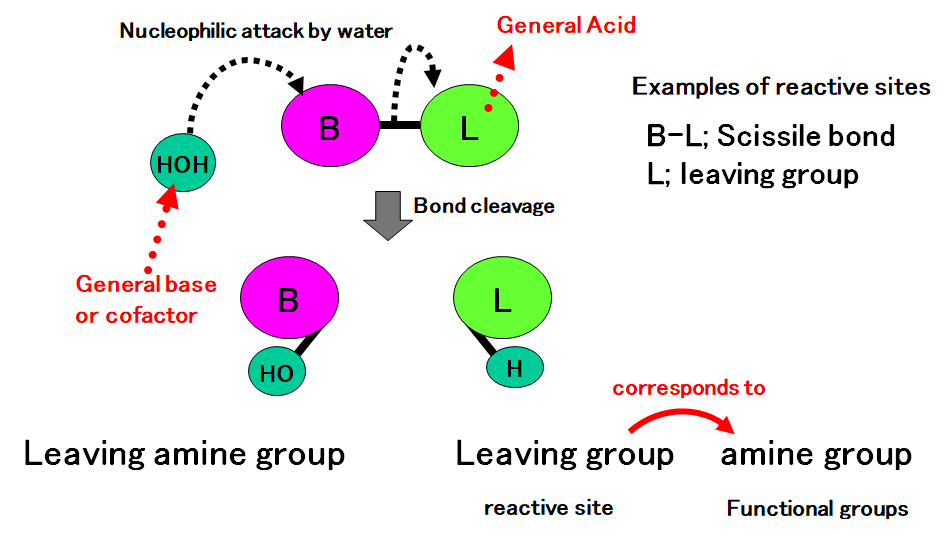
A typical example is “histone” as Other Compound and “substrate” as Entity Property, as indicated in the example below.
Glu-173 deprotonates the histone substrate.
T1 AminoAcid 0 7 Glu-173
T2 Deprotonation 8 20 deprotonates
T3 OtherCompound 25 32 histone
T4 EntityProperty 33 42 substrate
E1 Deprotonation:T2 Agent:T1 Theme:T3
A1 EntityAttribute T4 ReactionState
R1 corresponds_to Arg1:T4 Arg2:T3
The intermediate contains a negtively charged nitrogen leaving group.
T1 EntityProperty 4 16 intermediate
T2 FunctionalGroup 28 54 negtively charged nitrogen
T3 EntityProperty 55 68 leaving group
A1 EntityAttribute T1 ReactionState
A2 EntityAttribute T3 ReactivePart
R1 whole_part Arg1:T1 Arg2:T2
R2 corresponds_to Arg1:T3 Arg2:T2
Thus, the connected entities tend to be different, mostly from Entity Property to the other type of entities, unlike coreference and cataphora, although there are some exceptions.